|
|
|
| HOME / LIFESAVING / OUR
ABILITIES, TECHNIQUE AND EQUIPMENT |
|
|
 |
 |
| LIFESAVING CAPABILITIES |
|
|
OUR ABILITIES,
TECHNIQUE AND EQUIPMENT
Lifeguards have the capability to perform extraordinary rescues. We
are physically fit and regularly upskilled to perform the role of
the Lifeguard. Because of the varied nature of our coastline, the
public can expect to find the right blend of capabilities from experienced
lifeguards at their home beaches.
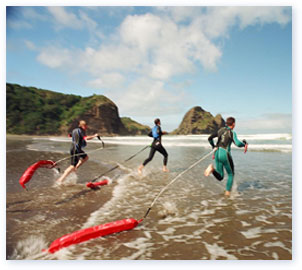
Rescue Tube
Our basic rescue unit is the Surf Lifeguard with a rescue tube and
swim-fins. A rescue tube is a flexible red neoprene floatation device
used for wrapping around a patient and clipping them in. A short length
of rope separates the tube from a webbing strap that is worn by the
lifeguard. Rescues are made by securing, then towing the patient to
shore using swim fins, surf and rips.
This method of rescue is very common and very effective for shorter
range rescues or those that must be performed close to rocks or areas
that other rescue methods either cannot access, or the risk would
be too great to try.
Inshore Rescue Boats - IRB
Our other major rescue technique involves two lifeguards and a 3.8m
inshore rescue boat (or IRB). These craft are powered by a modified
30 horsepower outboard engine and the fuel cell is a flexible bladder
of 20 litres capacity allowing these craft to operate in the surf
for approximately one hour at a time.
IRBs are designed to operate inshore on short trips in and around
the surf zone during the hours of daylight and are equipped with a
rescue tube, knife and two paddles. If capsize occurs, the crew is
trained to right the craft and `surf’ it in to shore. Depending
upon the skill and determination of the operator, these craft can
perform rescues very close to rock formations and be driven in very
large seas.
Rescue involves driving the boat to the patient and pulling them into
the craft. Rescue is typically performed by the crewperson but the
operator often assists. This is the preferred method for rescuing
unconscious patients. Once in the boat, expired air resuscitation
or CPR may be undertaken on the hard floor of these craft as the IRB
returns to shore.
Other rescue techniques exist and training is provided for them but
these do not account for many of our statistics.
Rescue Helicopter Services
Lifeguards occasionally train with rescue helicopter services and
many lifeguards are familiar with entering helicopters and exiting
into the water. At times helicopters will pick up lifeguards from
their beaches and drop them to the patient with rescue tube and fins.
Emergency Care
We have excellent basic first aid facilities at all patrolled locations.
Our volunteers are trained in first aid with an emphasis on resuscitation.
All surf lifesaving services in Surf Life Saving Northern Region are
equipped with automated external defibrillators. First Aid rooms are
typically set up with oxygen, bandages/misc, blankets, stretchers
and mobile oxygen kits are very common around the region.
Our membership is trained and equipped to only provide basic first
aid and resuscitation. They will call for medical back up at soonest
opportunity should it be required.
Our Training
Our volunteer membership is trained in surf rescue techniques. All
active members hold their Surf Lifeguard Award (Bronze Medallion)
and many hold their IRB Operators award. Typically lifeguards are
instructed to emergency care standards: 6402, 6401, 6400, 14470, 14471
and 14472 meaning that they are trained to use AED defibrillators
and medical oxygen. Most lifeguards are proficient with oxygen bag-valve-mask
resuscitation. Lifeguards frequently perform first aid on the beach-going
public and often travel within the community performing first aid
and resuscitation, even attending vehicle collisions.
Our Resources
We have an active membership of around 1100 lifeguards in our region.
These people have access to rescue and first aid equipment at all
of our locations during patrolling hours.
Surf Life Saving Northern Region owns one of the largest
private radio networks in the southern hemisphere, covering
and linking by repeater-network all of our services except
for Far North Surf Rescue at Ahipara. We use radios to
communicate with each other and with emergency services.
At all times that patrols are mounted on the beaches there
is a Surf Com Manager monitoring transmissions on the
network from the Communications Centre at the Auckland
Marine Rescue Centre at Mechanics Bay. This person liaises
between Surf Life Saving and other services and provides
a `safety net’ and advisory service for lifeguards
at the beach.
|
|
|
|
|



 ©
2003 Surf Life Saving Northern Region. All rights reserved. Powered
by Phase2 Internet Solutions. Terms and Conditions
| Privacy Policy
©
2003 Surf Life Saving Northern Region. All rights reserved. Powered
by Phase2 Internet Solutions. Terms and Conditions
| Privacy Policy